
Does provider self-reporting of etiquette behaviors improve patient experience? A randomized controlled trial


BACKGROUND
There is a glaring lack of published evidence-based strategies to improve the Hospital Consumer Assessment of Healthcare Providers and Systems (HCAHPS) patient experience scores on the physician domain. Strategies that have been used are resource intensive and difficult to sustain.
OBJECTIVE
We hypothesized that prompting providers to assess their own etiquette-based practices every 2 weeks over the course of 1 year would improve patient experience on the physician domain.
DESIGN
Randomized controlled trial.
SETTING
4 acute care hospitals.
PARTICIPANTS
Hospitalists.
INTERVENTION
Hospitalists were randomized to the study or the control arm. The study arm was prompted every 2 weeks for 12 months to report how frequently they engaged in 7 best-practice bedside etiquette behaviors. Control arm participants received similarly worded questions on quality improvement behaviors.
MEASUREMENT
Provider experience scores were calculated from the physician HCAHPS and Press Ganey survey provider items.
RESULTS
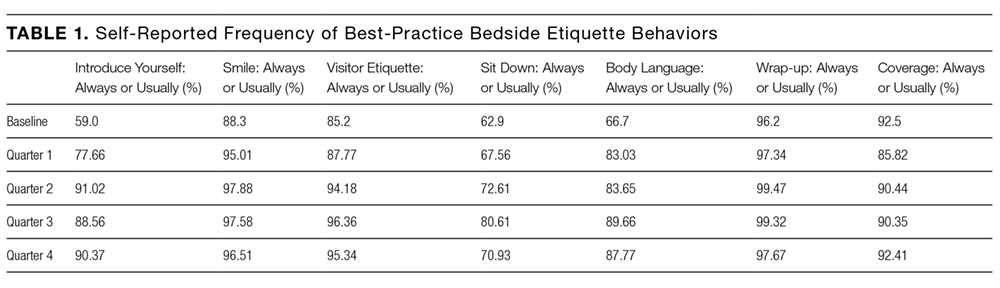
Physicians reported high rates of etiquette-based behavior at baseline, and this changed modestly over the study period. Self-reported etiquette behaviors were not associated with experience scores. The difference in difference analysis of the baseline and postintervention physician experience scores between the intervention arm and the control arm was not statistically significant (P = 0.71).
CONCLUSION
In this 12-month study, biweekly reflection and reporting of best-practice bedside etiquette behaviors did not result in significant improvement on physician domain experience scores. It is likely that hospitalists’ self-assessment of their bedside etiquette may not reflect patient perception of these behaviors. Furthermore, hospitalists may be resistant to improvement in this area since they rate themselves highly at baseline. Journal of Hospital Medicine 2017;12:402-406. © 2017 Society of Hospital Medicine
© 2017 Society of Hospital Medicine
Physicians have historically had limited adoption of strategies to improve patient experience and often cite suboptimal data and lack of evidence-driven strategies. 1,2 However, public reporting of hospital-level physician domain Hospital Consumer Assessment of Healthcare Providers and Systems (HCAHPS) experience scores, and more recent linking of payments to performance on patient experience metrics, have been associated with significant increases in physician domain scores for most of the hospitals. 3 Hospitals and healthcare organizations have deployed a broad range of strategies to engage physicians. These include emphasizing the relationship between patient experience and patient compliance, complaints, and malpractice lawsuits; appealing to physicians’ sense of competitiveness by publishing individual provider experience scores; educating physicians on HCAHPS and providing them with regularly updated data; and development of specific techniques for improving patient-physician interaction. 4-8
Studies show that educational curricula on improving etiquette and communication skills for physicians lead to improvement in patient experience, and many such training programs are available to hospitals for a significant cost.9-15 Other studies that have focused on providing timely and individual feedback to physicians using tools other than HCAHPS have shown improvement in experience in some instances. 16,17 However, these strategies are resource intensive, require the presence of an independent observer in each patient room, and may not be practical in many settings. Further, long-term sustainability may be problematic.
Since the goal of any educational intervention targeting physicians is routinizing best practices, and since resource-intensive strategies of continuous assessment and feedback may not be practical, we sought to test the impact of periodic physician self-reporting of their etiquette-based behavior on their patient experience scores.
METHODS
Subjects
Hospitalists from 4 hospitals (2 community and 2 academic) that are part of the same healthcare system were the study subjects. Hospitalists who had at least 15 unique patients responding to the routinely administered Press Ganey experience survey during the baseline period were considered eligible. Eligible hospitalists were invited to enroll in the study if their site director confirmed that the provider was likely to stay with the group for the subsequent 12-month study period.
Randomization, Intervention and Control Group
Hospitalists were randomized to the study arm or control arm (1:1 randomization). Study arm participants received biweekly etiquette behavior (EB) surveys and were asked to report how frequently they performed 7 best-practice bedside etiquette behaviors during the previous 2-week period (Table 1). These behaviors were pre-defined by a consensus group of investigators as being amenable to self-report and commonly considered best practice as described in detail below. Control-arm participants received similarly worded survey on quality improvement behaviors (QIB) that would not be expected to impact patient experience (such as reviewing medications to ensure that antithrombotic prophylaxis was prescribed, Table 1).


