
World Wide Med: Helping Out in Libya


Dr. Kwan Kew Lai is one of those people who has to add extra pages to her passport. Her global health resume includes a 2009 trip to treat AIDS patients in South Africa and travel to Haiti in 2010 to help those affected by a devastating cholera outbreak.
But in 2011 she took on a challenge that gave even this veteran of the skies pause. Dr. Lai traveled to Libya to work in several different clinics during the revolution in the fall of 2011. She made the trip with the help of Medical Teams International, a nonprofit medical relief organization, in collaboration with the International Medical Corps (IMC).
What inspired you to go to Libya at such a dangerous time?
In July, I first heard about the possibility of going to Libya to offer medical relief from IMC, but I was still volunteering in Nakivale Refugee Camp in Uganda. My heart skipped a beat. I knew that I wanted to go. I had been following the Libyan revolution closely and felt passionate about the people’s desire to be free from a dictator. Going to Libya offered me the opportunity to help the people of Libya who were fighting hard to gain their freedom as well as the people fleeing the war. The other part of me liked to face the challenge of working in a war zone, something that I have wanted to experience. I did go with trepidation; the fear of stray bullets and getting hurt was real, and I am not going to downplay that.
Who were your patients?
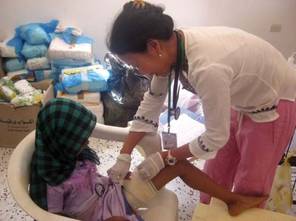
Mostly I was seeing people in clinics that we set up in places where the internally displaced people stayed. Many of these people presented with garden-variety chronic health conditions, such as diabetes and hypertension, and needed to get more medications for their conditions. I saw many pregnant women who needed to go to big cities like Misurata and Tripoli, and for that they needed to get a letter from a doctor in order to get through the various checkpoints. Between Misurata and Tripoli, there were at least 24 checkpoints. Other patients included injured fighters, and civilians who had been injured in the cross fire. These were the lucky ones who were able to escape the city.
Was it difficult to obtain medications?
I was actually quite surprised that we were able to get the medications that we needed. The local Libyans were able to take us to an unmarked pharmacy to buy medications and other supplies.
What precautions did you have to take for your safety?
In the Nafusa Mountain areas, we were told not to go out without the escort of a man, but that ban was lifted when there was no one to escort us. Once the fighting had died down in Misurata, I was able to move about and even go out for a run early in the morning without a problem, but I still had to clear it with the security personnel. Men carrying weapons and vehicles with antiaircraft artillery were disturbing sights at first, but I got used to it after a while.
Could you describe the facilities?
The clinic in Awlad Taleb near Tiji is clean but devoid of equipment. They have 28 nurses and 3 social workers, but no doctors. Some nurses were sitting around with no work to do. This facility is meant to serve 6,000 people. We bypassed another hospital that is now nonfunctional because it has been partially destroyed, and the equipment was taken by military forces to another hospital along the western border of Libya near Tunisia.
In Badr we visited a clinic whose daily census used to be 120 and was then down to 25 patients a day. The facility is badly in need of repair. It lacks equipment and personnel, especially doctors. There are 70 nurses. In the front hallway, prominent bullet holes were seen with graffiti spray-painted over the top in Arabic.
At Tawarga, we moved our mobile clinic to a former apartment building, and the facilities were better. We took care of many of the displaced persons there. The grounds were cleaner; there was electricity and running water. The diabetic patients now could keep their insulin in a refrigerator if they could find one. All displaced persons from a less secure area were moved here.

