
Niacin in AIM-HIGH: Knowing When to Stop



It’s routine for large clinical trials to have a data and safety monitoring committee, a panel with the sole function of following the results of a trial to make sure patients are not systematically hurt by an investigational treatment, and to also make sure that over the course of the several years it often takes to run these large studies they remain valid, with a chance of proving the study’s underlying hypothesis.
In the case of the AIM-HIGH trial, which tested the idea of adding extended-release niacin treatment to statin therapy for patients with cardiovascular disease, the data and safety monitoring board acted on both these issues and recommended last April that the trial stop abruptly, about 18 months short of its intended completion date and with nearly a third fewer cardiovascular disease events than the original study design had projected. When Dr. William Boden, leader of AIM-HIGH study, reported the results earlier this month at the American Heart Association Scientific Sessions in Orlando, the decision to stop the trial early for both safety and futility issues came under scrutiny.
Early stoppage seemed a sore point not only because of diverging opinions about the validity of the decision, but also because the stunted duration of the study and event shortfall produced findings that critics deemed statistically unreliable and meaningless. As my colleague reported earlier this month, Dr. Philip Barter, the designated discussant for AIM-HIGH, pointedly said “I do not believe that we should draw any conclusions or change clinical practice on the basis of this underpowered study.”
Why did the data and safety monitoring board pull the plug? Dr. Boden cited two factors, although he himself was not a member of that board. First, at its April assessment, the committee found the results had crossed a pre-specified boundary for lack of efficacy. Based on the results to that date, the committee identified a less than one in 10,000 likelihood that the data would ever show a significant efficacy benefit from the added niacin treatment, he said.
The second issue, safety, focused on an “unexpected” excess of ischemic stroke among the patients who received the full niacin dosage tested.
At the time the safety issue looked real, but it subsequently faded. After all the ischemic strokes underwent careful review, the event tally stood at 15 in the placebo group and 27 in the patients on extended-release niacin. While the number may have been higher in the niacin group, it was not a statistically significant difference. As Dr. Boden said at the meeting, the concerning stroke signal seen last April was “just a statistical anomaly, a play of chance.” If the fuller analysis had been know last April, the data and safety monitoring board would presumably not have stopped the trial for safety.
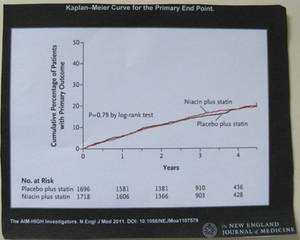
The futility issue is stickier. The final results continue to show superimposed event curves for both arms of the study for the entire actuarial follow-up (first graph, left). Although the actuarial analysis shows time on treatment for more than 4 years, the average time on treatment for patients in the study was about 3 years, more than 1.5 years less than originally planned.
During the discussion of his report in Orlando, in reply to a question on whether it might take niacin longer to exert a benefit, Dr. Boden harkened back to a 1999 study, VA-HIT, that assessed the impact of the fibrate gemfibrozil for treating abnormal cholesterol levels in men with coronary disease. The Kaplan-Meier curves for the primary endpoint in the two treatment arms of VA-HIT (second graph, left) “were spot-on superimposed for the first 18-24 months,” he said. “It’s uncertain what would have happened if AIM-HIGH had a longer follow-up; we might have seen something different,” he acknowledged.
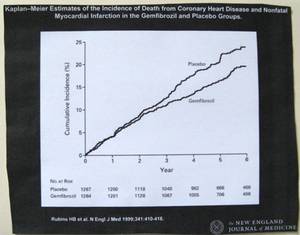
A lipidologist not associated with the study put it in much blunter terms. “It was a tragic blunder to stop it short,” Dr. Eliot Brinton told me. “Look at VA-HIT. The curves were superimposed until almost 3 years,” The VA-HIT study had a median follow-up of just over 5 years.
Dr. Brinton then added the main argument for adopting a very high threshold for stopping a trial early for the reason of suspected futility: the lack of much gain from stopping a big trial that was already under full steam, and the possible loss of important insights from an additional 18 months of treatment and accrued events.

