
A new standard of care for relapsed/refractory MM?


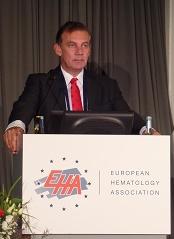
COPENHAGEN—The combination of daratumumab, lenalidomide, and dexamethasone (DRd) could become a new standard of care for patients with relapsed or refractory multiple myeloma (MM), according to a speaker at the 21st Congress of the European Hematology Association.
In the phase 3 POLLUX study, DRd conferred the highest response rate reported to date in the treatment of relapsed/refractory MM.
DRd also significantly improved progression free survival (PFS) when compared to treatment with lenalidomide and dexamethasone (Rd).
In addition, the safety profile of DRd was manageable and consistent with results observed in previous studies, according to Meletios A. Dimopoulos, MD, of the National and Kapodistrian University of Athens in Greece.
Dr Dimopoulos presented these results at the congress as abstract LB2238. The POLLUX study was funded by Janssen Research & Development, LLC.
Treatment and patients
POLLUX was a randomized, double-blind study that enrolled 569 patients with relapsed or refractory MM. Patients had received 1 or more prior lines of therapy and had progressive disease.
The patients were randomized to receive DRd (n=286) or Rd (n=283). All patients received lenalidomide at 25 mg on days 1-21 of each cycle until disease progression. They also received dexamethasone at 40 mg weekly until disease progression.
Patients in the daratumumab arm also received daratumumab at 16 mg/kg once a week in cycles 1-2, every other week in cycles 3-6, and once every 4 weeks until disease progression.
Dr Dimopoulos noted that patient and disease features were equally distributed between the treatment arms. The median age was 65 in both arms (overall range, 34-89). About half of patients in each arm had ISS stage I disease, and patients were, roughly, a median of 4 years from diagnosis.
In both arms, patients had a median of 1 prior lines of therapy (overall range, 1-11). Roughly 60% of patients in both arms had received a prior transplant, 86% had received a proteasome inhibitor, 55% had received an immunomodulatory agent, 18% had prior lenalidomide, and 44% had received a proteasome inhibitor and an immunomodulatory agent.
Roughly 28% of patients in each arm were refractory to a proteasome inhibitor, and nearly 30% were refractory to their last line of therapy.
Results
At a median follow-up of 13.5 months, about 35% of patients had discontinued treatment—23% in the DRd arm and 47% in the Rd arm.
Reasons for discontinuation included disease progression (14% and 34%, respectively), adverse events (7% and 8%, respectively), non-compliance with study drug (0.4% and 2%, respectively), withdrawal by patient (0.4% and 2%, respectively), physician decision (1% and 0.7%, respectively), and death (0.7% and 0.4%, respectively).
The study’s primary endpoint was PFS. The median PFS has not been reached in the DRd arm and was 18.4 months in the Rd arm. The 12-month PFS was 83% and 60%, respectively, and the 18-month PFS was 78% and 52%, respectively.
“There is an unprecedented improvement of progression-free survival in favor of daratumumab with lenalidomide and dexamethasone, with a hazard ratio of 0.37 [95% CI, 0.27-0.52; P<0.0001], which corresponds to a 63% reduction in the risk of progressive disease or death in favor of DRd,” Dr Dimopoulos said.
He also pointed out that the improvement in PFS for the DRd arm was seen across all patient subgroups, regardless of age, ISS stage, prior treatment, and type of MM.
Furthermore, response rates were significantly higher in the DRd arm than in the Rd arm. The overall response rates were 93% and 76%, respectively (P<0.0001). And the complete response rates were 43% and 19%, respectively (P<0.0001).

