
Image of family medicine— not yet picture-perfect



An uneasy relationship between the specialty of family medicine and US-based medical students is reflected in the 2008 residency match. We were fortunate to fill nearly 91% of residency positions, which compares favorably with the last 10-year peak, 89% in 1997. But a more telling statistic is the shrinking percentage of slots filled by US graduates. Only 44.2% are from US medical schools, compared with nearly 72% in 1997.1 Family medicine attracts well-trained foreign medical graduates, but is becoming less attractive to US grads.
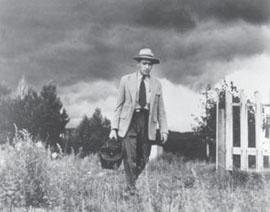
ALTRUISM AND SELFLESSNESS, STILL THE CORE OF OUR SPECIALTY. W. Eugene Smith’s 1948 Life magazine essay “Country Doctor” opened with this photo of Dr. Ernest Ceriani, age 32, taking a short cut from house to hospital, in Kremmling, Colorado. Today, the ideal of the family physician is the touchstone for a minority of US medical students when it comes to choosing their career specialty.
Why? Much has been written about the emphasis among students on “lifestyle” and income.2 Funny thing, lifestyle. It would be challenging for me to give up the work I love for another line of work entirely, even if it meant fewer hours. But the fact that students seem to blithely choose between family medicine and neuroradiology as if they were equivalent commodities tells me we have a long way to go to convince students of the true joy of primary care.
The P4 (Preparing the Personal Physician for Practice) initiative, the specialty’s latest effort to reinvigorate training,3 joins the Future of Family Medicine project4 as being heavy on conceptual aspects, with outcomes still pending.
Role models scarce
Meanwhile, I suggest we focus on the obvious: students do not encounter enough well-trained family physicians as they receive their education at tertiary/quaternary care centers, where specialist medicine prevails. I was fortunate to train at a center with a strong presence of FPs—role models of generalism who were excellent in ambulatory, hospital, obstetric, and pediatric settings within their chosen range of practice. No one had to tell me; I could see it for myself: the smartest people I knew were FPs. Unfortunately, my experience was markedly different from that of students in other settings, some of which do not even have a department of family medicine.
Excellence attracts excellence
Some of our recruitment efforts are hopelessly inadequate, appealing solely to altruism and selflessness. You may be shocked by that statement. (Keep away from residency fairs!) We have to understand, however, that the students swayed by altruism and selflessness will choose our specialty anyway. While supporting this core, we need to convince undecided students, who will choose their specialty on the merits of the narrow universe they are exposed to in medical school. Undecided students often choose other specialties because they do not receive reinforcement from peers or attendings about the technical skills, cerebral nature, and overall competence needed for a career in family medicine.
THE AUTHOR
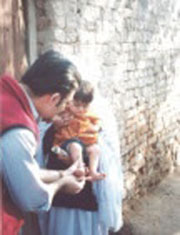
Dr. Khan examines a child newly diagnosed with poliomyelitis. He was working with a World Health Organization team doing polio vaccinations in remote parts of Pakistan, in 2006.Misconceptions about salaries abound. More than once I have shared salary data from the Medical Group Management Association with students and residents who were surprised that salaries are “higher than what I’ve been told.” It doesn’t help that most medical schools do not actively share earnings information with students.
It is the nature of medical education that we admit to medical school individuals who are competitive and who have excellent grades and MCAT scores. These students are accustomed to aiming for “the best.” Expecting them to, in a sense, “lower their expectations” to primary care is exactly the wrong approach. Family medicine in tertiary care centers needs to emulate the centers of excellence around the country where FPs conduct clinical research, pioneer evidence-based tools, lead global health efforts, and provide measurably excellent primary care.
Furthermore, fewer non-family medicine primary care positions were offered in the 2008 match, and fewer individuals are choosing primary care. The obvious conclusion? We are increasingly the specialty responsible for delivering primary care—and the last time I checked, still the only one specializing in generalism.
Misconceptions about generalism
We are thus faced with reforming not just our specialty but how we portray it. Yes, the ideal of the country doctor resonates deeply with me. But these icons are meaningful touchstones for only a minority of medical students. For the majority, that’s not enough. They need to see the best thinkers in the field, and see for themselves the evidence base in use in our daily practices. They need exposure to the variety of arenas that makes up our medical home—the hospital, the obstetrics floor, the newborn ward, and our clinic. In all these settings, our challenge is to demonstrate that generalism is not an excuse for anything less than the standard of care, and excellence as well as efficiency. Our work needs to be on or above par with specialty colleagues providing the same service, but with the added benefit of extended family relationships and comprehensive care.


