
Madhavi Dandu, M.D. - MPH Hospitalists’ particular skills are great for global health


Associate professor of clinical medicine, UCSF
Interim director, master’s in global health, UCSF
Director of global health pathway, internal medicine residency, UCSF
Trend to watch: Systems-based approach to tackling global health issues
Dr. Madhavi Dandu, a hospitalist at the University of California in San Francisco, became interested in addressing health disparities around the globe at an early age. During childhood, Dr. Dandu spent many summers in India, where she was born and lived until age 2. She quickly began to notice the stark economic and health differences between the small Indian villages she visited and her home in Michigan.
As she pursued a career in medicine, Dr. Dandu began to look for opportunities to work and learn in low-resource settings in order to address severe health disparities. Today, Dr. Dandu continues her global health work and mentors residents who also are looking to make a difference in underserved communities locally and internationally. She is part of a growing cadre of global health hospitalists at UCSF and is the associate director of the Pathways to Discovery Program in Global Health, which trains UCSF undergraduate and graduate students for careers in global health.
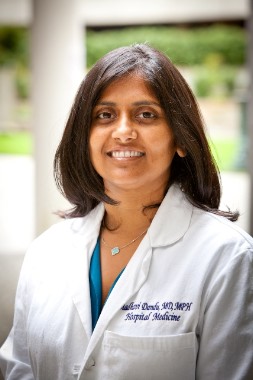
In an interview with Hospitalist News, Dr. Dandu explained why hospitalists are well suited to help globally and how international medical work can improve hospital care back at home.
Question: Describe one of your favorite global health experiences.
Dr. Dandu: When I was a resident working in Uganda there was a clinic that we worked with called a reach-out clinic, in Kampala. It was on the outskirts of the city, on the edge of the electric grid. So some people are on the electricity grid and some aren’t. It’s a relatively marginalized population with many internally displaced refugees from the country’s recent civil war.
The clinic was started by a Danish physician, who came to Uganda with her husband, who was working for the World Food Program. Around 2000, at the same time that HIV/AIDS was becoming recognized as a significant problem in sub-Saharan Africa, she was getting to know the community and met a local priest. He said to her, ‘You’re a physician, walk with me to these homes. People are wasting away and they are dying.’ She started by going from home to home with her medical bag. Eventually, enough people started coming to see her that she set up a small clinic in the church.
When we went there a few years later, she had built up a whole infrastructure with some of the best elements of global health. The clinic is almost entirely Ugandan run. They provide diagnostics and regular treatment plans, but also peer education programs, a food access program, a job skills program, and an adult literacy program. Everything is deeply embedded in the clinic system, but it’s also deeply embedded in the community. That clinic is an example to me of the systems-building process that I really like about global health and I learned a lot during that experience.
Question: What’s it like when you don’t have the usual diagnostic tools and medicines at your fingertips? Freeing or frustrating?
Dr. Dandu: There is something really refreshing, in some ways, about being in a place where it’s all about interacting with the patient and their family and a lot less about the system and the documentation. A lot of times when you’re abroad, depending on the setting, it’s a lot of time with people, from the coclinicians to the patients. I really like that part. But it can also be frustrating. The diagnostic part can be difficult. But what’s most frustrating is not being able to offer people quite as much as you wish that you could either because you don’t have access to certain resources or it’s hard to get them to the right place at the right time.
Question: Why do you think global health is potentially a good fit for hospitalists?
Dr. Dandu: Many people, including myself, originally thought of it as a good fit because of the schedule. When hospitalists are on service we have clinical responsibilities, but when we’re off service, the schedule allows flexibility. But I actually think hospitalists have a lot more to offer than just the schedule. Hospitalists know a lot about working in systems. What defines hospital medicine in some ways is the focus on quality, safety, and quality improvement.
As we move forward in global health, a lot of the work will be about helping countries and communities build health systems that are sustainable and not dependent on international health professionals and development aid. Fundamentally, everyone deserves high quality care at a reasonable price and hospitalists know how to use resources well and find efficiencies in systems.

