
Hospitalist’s regulatory roundup: Medicare penalties adding up for doctors, hospitals


October marks the start of a new fiscal year for the federal government and with it comes a host of new and revised regulatory requirements for hospitalists and hospitals.
Medicare officials are using some carrots – but mostly sticks – to get hospitals and doctors to improve quality and lower costs. Some of the programs levy financial penalties on hospitals but affect the day-to-day work of hospitalists, while others affect physicians at the individual level.
"There’s a lot of confusion and lack of knowledge about what’s occurring at the physician level and what’s occurring at the hospital level," said Dr. Patrick J. Torcson, a member of the board of directors of the Society of Hospital Medicine (SHM) and director of hospital medicine at St. Tammany Parish Hospital in Covington, La.
Carrots, sticks for hospitalists
Two programs will touch hospitalists – and their wallets – directly. Medicare’s Physician Quality Reporting System (PQRS), a voluntary pay-for-reporting program, has been around since 2007 offering small incentives for participation, but it will soon begin penalizing physicians who don’t report on quality. Officials at the Centers for Medicare and Medicaid Services (CMS) are also phasing in the physician value-based modifier, which will begin adjusting physician payments up or down depending on the quality and cost of the care they provide.
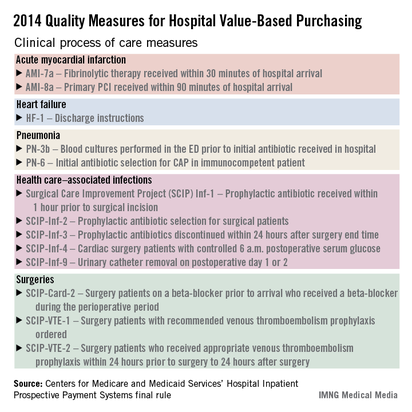
CMS will use PQRS reporting as the basis for the new modifier, making participation in the older program a top priority for all physicians, Dr. Torcson said.
This year, physicians who successfully report quality measures through PQRS can earn a 0.5% bonus on their total allowable Medicare Part B charges. The same bonus will be in place for 2014. But starting in 2015, Medicare will assess a 1.5% penalty on physicians who fail to report successfully. That payment penalty increases to 2% in 2016.
But the PQRS has been criticized as being cumbersome and not especially relevant for hospitalists.
"I think many physicians hoped it would go away," Dr. Torcson said. "It hasn’t. It has expanded."
Hospitalists are currently required to report on at least three quality measures through the program. But Medicare is proposing to require physicians to report on at least nine measures starting in 2014. CMS will issue a final regulation outlining changes to the PQRS in November.
The SHM has recommended instead that CMS limit the expansion to no more than six quality measures to keep from ramping up the program too fast.
In comments to the agency, SHM also noted that the PQRS quality measures, while improving, still do not accurately reflect the scope of care provided by hospitalists. For instance, about half of the measures that hospitalists can report on are related to stroke care, though stoke care is not a primary practice focus for many hospital medicine programs.
Many hospitalists have ignored the PQRS so far, Dr. Torcson said, because the added time and effort of reporting on quality measures outweighed the value of the 0.5% bonus, on average about $500 per physician. But he urged physicians to rethink participation in light of the rollout of the new value-based modifier program.
Value-based modifier coming soon
The physician value-based payment modifier was part of the 2008 Medicare Improvement for Patients and Providers Act and was expanded as part of the 2010 Affordable Care Act. The program seeks to pay physicians more for providing high-quality, low-cost care. But the budget-neutral program will pay less for low-quality, high-cost care. Physician groups could see payment cuts of between 1% and 2% in 2016, based on their performance. Physicians who don’t report on quality measures through the PQRS will get an automatic 1% pay cut under the value-based modifier program.
The value-based modifier already is affecting physicians who work in groups of 100 or more eligible providers. While payments won’t be affected until 2015, CMS will base its adjustments on the data reported to the PQRS in 2013. The program will expand to cover physician groups of 10 or more in 2016, though the measurement on cost and quality will occur in 2014. Payments for all physicians will be subject to the modifier by 2017, based on performance during 2015.
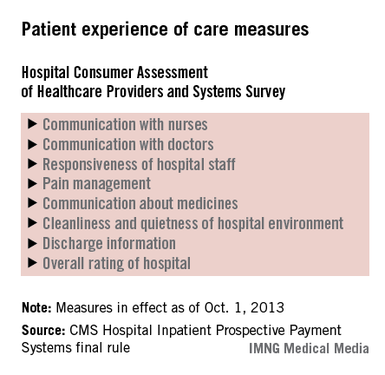
"Physician-level pay for reporting is well underway and now actual pay for performance is here," Dr. Torcson said. "Engagement, familiarity, and participation in the PQRS is really going to be the key for physicians. It’s not too late."
CMS is providing some tools to help physicians understand their performance on cost and quality. The agency is producing annual Quality and Resource Use Reports (QRURs) that will show the individual physician’s past performance on the measures chosen by CMS. The reports are scheduled to go out to groups of 25 or more eligible professionals this fall. All physicians should start receiving the reports sometime in 2014.

