
SAA patients benefit from upfront eltrombopag combo


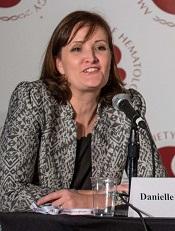
Photo courtesy of ASH
ORLANDO, FL—Investigators are pursuing an upfront approval for eltrombopag in combination with immunosuppressive therapy for the treatment of severe aplastic anemia (SAA).
Based on eltrombopag’s single-agent activity in refractory SAA, they hypothesized that its addition to standard immunosuppressive therapy of horse antithymocyte globulin (hATG) and cyclosporine (CsA) in the first-line setting could improve patient outcome.
And, in a phase 2 trial, it did.
“The addition of eltrombopag resulted in over 20% higher overall response rates and complete response rates for both 3 and 6 months,” said Danielle
Townsley, MD, who presented the data at the 2015 ASH Annual Meeting.
Dr Townsley, of the National Heart, Lung, and Blood Institute, National Institutes of Health, in Bethesda, Maryland, presented the findings as abstract LBA-2.*
The US Food and Drug Administration approved eltrombopag to treat refractory SAA in November 2014, and the European Commission approved it in 2015.
Investigators believed eltrombopag in the upfront, treatment-naïve setting could yield higher overall response rates (ORRs) than the 60% to 70% achieved with standard immunosuppressives worldwide.
“[It was] logical to consider treating patients early at the start of their disease,” Dr Townsley said.
So she and her colleagues conducted an investigator-initiated, phase 2, single-center trial of eltrombopag combined with immunosuppressive agents for first-line treatment of SAA.
Study design and patient population
Patients had to have confirmed treatment-naïve SAA, be a minimum of 2 years old, and weigh more than 12 kg. They were excluded if they had prior immunosuppressive therapy with ATG, alemtuzumab, or cyclophosphamide. They were also excluded if they had liver cirrhosis, AST/ALT more than 5 times normal, or Fanconi anemia.
Primary endpoints of the study were complete response (CR) at 6 months and toxicity. Secondary endpoints included ORR and partial response (PR) rate, survival, clonal evolution, and relapse.
Investigators defined CR as having an absolute neutrophil count (ANC) of 1000/μL or higher, a hemoglobin level of 10 g/dL or higher, and a platelet count of 100,000/μL or higher. They defined PR as blood counts no longer meeting criteria for SAA or CR.
All 92 patients received standard hATG (on days 1 to 4) and CsA (for 6 months). Patients in cohort 1 (n=30) also received eltrombopag at 150 mg daily, starting on day 14 for 6 months.
Patients in cohort 2 (n=31) received eltrombopag at 150 mg daily, starting on day 14 for 3 months. And the 31 patients in cohort 3 started 150 mg of daily eltrombopag simultaneously with the immunosuppressants and continued to receive the drug for 6 months.
Investigators assessed response at 3 and 6 months and planned to follow patients for at least 5 years.
Patients in all cohorts were a median of 32 years (range, 3–82), with 21% being younger than 18. About half were male, 66% had less than 1% of a paroxysmal nocturnal hemoglobinuria clone, 37% had a median neutrophil count less than 200/μL, a median reticulocyte count of 20,000/μL (range, 1600–60,400/μL), and a median platelet count of 9000/μL (range, 0–37,000/μL).
Results
At 3 months, the ORR for the entire population was 81%, and the CR rate was 28%. The ORR was 77% in cohorts 1 and 2 and 92% in cohort 3. The CR rate was 17%, 26%, and 44% in cohorts 1, 2, and 3, respectively.
At 6 months, the ORR for the entire population was 86%, and the CR rate was 37%. The ORR was 80%, 87%, and 95% in cohorts 1, 2, and 3, respectively. And the CR rate was 33%, 26%, and 60%, respectively.

