
Prognosticating with the hospitalized-patient one-year mortality risk score using information abstracted from the medical record


BACKGROUND
Predicting death risk in patients with diverse conditions is difficult. The Hospitalized-patient One-year Mortality Risk (HOMR) score accurately determines death risk in adults admitted to hospital using health administrative data unavailable to clinicians and most researchers.
OBJECTIVE
Determine if HOMR is valid when calculated using data abstracted directly from the medical record.
DESIGN
Medical record review linked to population-based administrative data.
PARTICIPANTS
4996 adults admitted in 2011 to a nonpsychiatric service at a tertiary hospital.
MAIN MEASURES
From the chart, we abstracted information required to calculate the HOMR score and linked to population-based mortality data to determine vital status within 1 year of admission date.
KEY RESULTS
Patients had a mean age of 55.6 (standard deviation [SD], 20.7) with 563 (11.3%) dying. The mean chart HOMR score was 22 (SD, 12) and significantly predicted death risk; a 1-point increase in HOMR increased death odds by 19% (odds ratio, 1.192;, 95% confidence interval [CI], 1.175-1.210;, P < 0.0001). Chart HOMR was strongly discriminative ( C statistic 0.888) and well calibrated (Hosmer-Lemeshow goodness-of-fit test, 12.9; P = 0.11). The observed death risk was strongly associated with expected death risk (calibration slope, 1.02; 95% CI, 0.89-1.16). Notation of delirium or falls on admitting notes or dependence for at least 1 activity of daily living were each associated with 1-year death risk independent of the HOMR score.
CONCLUSIONS
One-year mortality risk can be accurately determined in adults admitted to hospital with the HOMR score calculated using information abstracted from the medical record. Patient functional status was independently associated with death risk. Journal of Hospital Medicine 2017;12:224-230. © 2017 Society of Hospital Medicine
© 2017 Society of Hospital Medicine
A patient’s prognosis can strongly influence their medical care. Decisions about diagnostic modalities, treatment options, and the use of preventive therapies can all be affected by the likelihood of a patient’s death in the near future. For example, patients with severely limited survival might forego prophylactic therapy, avoid interventions for asymptomatic issues, and cease screening interventions. Knowing survival probability would also be very helpful as a controlling variable in research analyses whenever death risk might be a possible confounder.
Sixteen indices that aim to predict patient death risk have been described by Yourman et al.1 They were all created from secondary analyses of clinical and administrative datasets, were applicable to patients in a variety of settings (including the community, nursing home, or hospital), and predicted survival probabilities in time horizons ranging from 6 months to 5 years. Prognostic factors that were most commonly included in these indices were comorbidity and functional status. In validation populations, the discrimination of these indices for 1-year survival in hospitalized patients was moderate (with C statistics that ranged from 0.64 to 0.79) with good calibration for broad prognostic ranges.
In 2014, we published the Hospitalized-patient One-year Mortality Risk (HOMR) score.2 This study used health administrative data for all adult Ontarians admitted in 2011 to hospital under nonpsychiatric services (n = 640,022) to estimate the probability of dying within 1 year of admission to hospital (which happened in 11.7% of people). The HOMR score included 12 patient and hospitalization factors (Table 1). It was highly discriminative (C statistic, 0.923; [0.922-0.924]) and well calibrated (the mean relative difference between observed and expected death risk was 2.0% [range, 0.0% to 7.0%]). It was externally validated in more than 3 million adults from Ontario, Alberta, and Boston in whom the C statistic ranged from 0.89 to 0.92 and calibration was excellent.3 We concluded from these studies that the HOMR score is excellent for prognosticating a diverse group of patients using health administrative data.
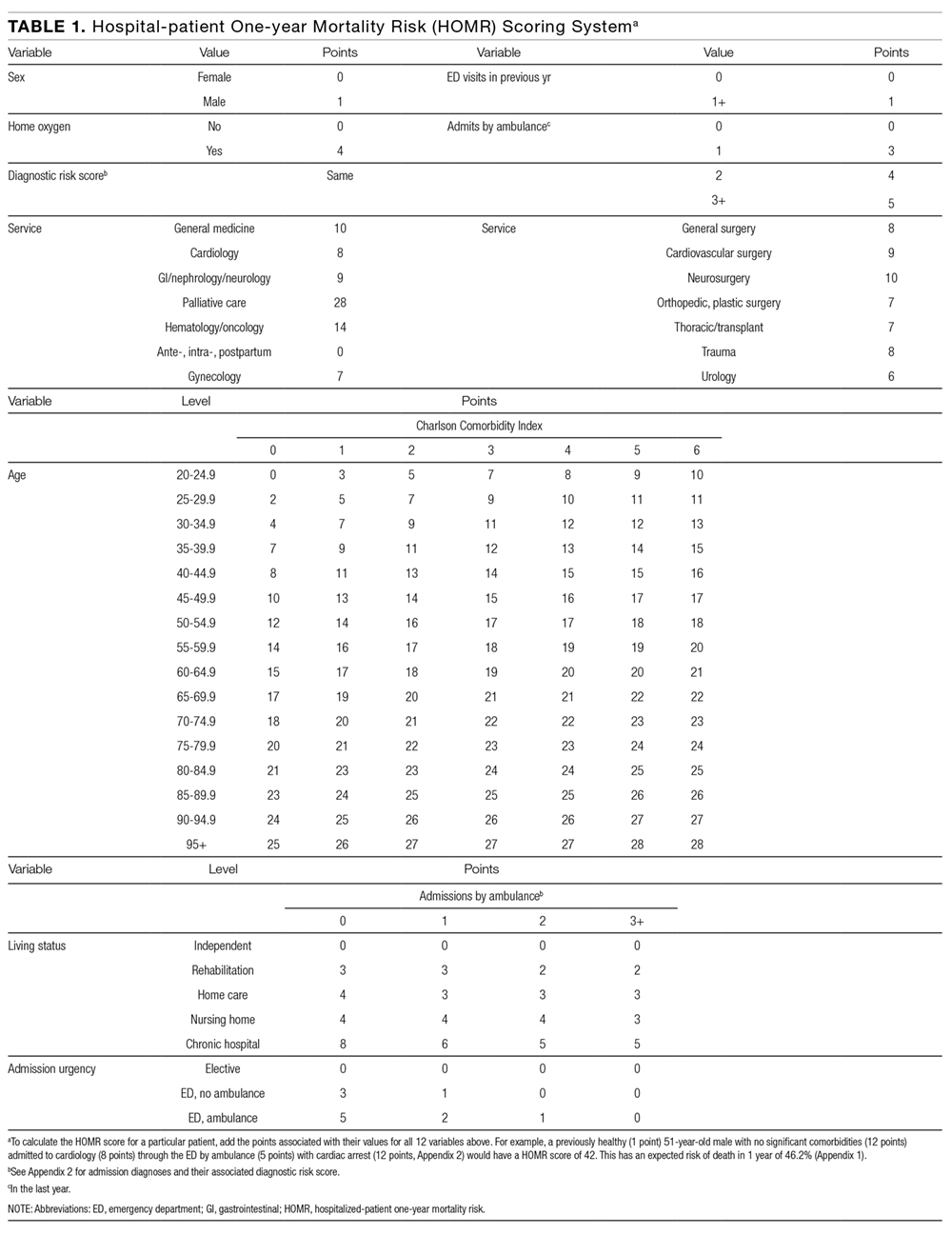
However, we do not know whether the HOMR score can be applied to patients using primary data (ie, those taken directly from the chart). This question is important for 2 reasons. First, if HOMR accurately predicts death risk using data abstracted from the medical record, it could be used in the clinical setting to assist in clinical decision-making. Second, HOMR uses multiple administrative datasets that are difficult to access and use by most clinical researchers; it is, therefore, important to determine if HOMR is accurate for clinical research based on primary medical record review. The primary objective of this study was to determine the accuracy of the HOMR score when calculated using data abstracted from clinical notes that were available when patients were admitted to hospital. Secondary objectives included determining whether functional measures abstracted were significantly associated with death risk beyond the HOMR score and whether HOMR scores calculated from chart review deviated from those calculated from administrative data.


