
Practice Profile


Contact
Mark Kulaga, MD
Associate Program Director
Internal Medicine Residency
Norwalk Hospital
Norwalk, CT 06856
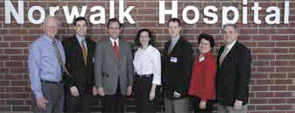
Physician Staff
Pamela Charney, MD
Joseph Cleary, MD
Mark Kulaga, MD
Eric Mazur, MD
Stephen O’Mahony, MD
Jason Orlinick, MD, PhD
Andrea Peterson, MD
Other Staff
Michael Marotta, PA
Start Up
July 1999
Hospital Setting
Norwalk Hospital, Norwalk, CT
Academic Community Hospital with 250 beds
Affiliated with Yale University
Patient Population
Our patient population is wonderfully diverse, both economically and socially. Located in the heart of affluent Fairfield County, Norwalk is nevertheless a true small city and home to vibrant communities of African Americans, Latinos, and multiple other immigrant groups. The Hospitalist Clinician-Educator program was originally created to provide inpatient care for indigent patients (who predominantly attend the Norwalk Community Health Center) and for those patients without a local primary care physician. In recent years, as more community internists have chosen to use the hospital medicine service, our payer mix has substantially changed to include many more patients with private insurance and/or Medicare.
Employer
All physicians are general internists employed by the Norwalk Hospital.
Organization/Management
Dr. Eric Mazur, Chairman of the Department of Internal Medicine, is the program founder and administrative leader. He serves as the primary liaison between the hospitalists and the Chief Executive and Operating Officers of the hospital.
Total Number of Patients Served Each Year
On average, each hospitalist admits 350 patients per year. When this threshold is exceeded, a new hospitalist has been added to the group. In the first few years of service, our hospitalists covered 20-25% of the total number of medical admissions to the Norwalk Hospital. As use of the service by local internists has increased, this percentage has grown to 40–45%. It is projected that the Norwalk Hospital hospital medicine service will admit over 2200 patients this year.
Compensation/Schedules
All hospitalists receive a fixed annual salary. The hospital subsidizes 50% of each Hospitalist Clinician Educator position and bills the faculty practice income for the remaining 50%. Faculty practice income is generated through direct patient billing facilitated by a billing agency not affiliated with the hospital. The hospital also provides an annual stipend to the faculty practice for the indigent care supplied by the hospital medicine group. Our compensation model does not utilize an incentive bonus system, although yearly bonuses derived from surplus faculty practice revenue are provided at the discretion of the Chairman.
All hospitalists admit and co-manage patients with resident teams who provide 24/7 in-house coverage. Each hospitalist typically works Monday through Friday from approximately 7–8 a.m. until 5:30–6:30 p.m. depending on patient census. Hospitalists, along with other members of the full time faculty, provide nighttime backup coverage from home for the residents. Weekend coverage responsibilities are also shared with other members of the teaching faculty. Weekend moonlighters, all of whom are board-certified or board-eligible internists from nearby communities, assist full-time faculty members with coverage on Saturdays and Sundays.
Communication Strategies/Role in Education
All of our hospitalists are highly rated by medical residents for their effectiveness as teachers and supervisors. For many, they also serve as important mentors and role models. In addition to traditional educational roles on the inpatient service, our hospitalists have developed several innovative teaching conferences, which include: teaching skills workshops; weekly medical informatics sessions; a monthly medical quiz game incorporating content from core educational conferences; a multidisciplinary Morbidity and Mortality Conference in which residents from the internal medicine and radiology departments are key participants; and a series of conferences in which end-of-life issues and physician professional development are explored in great depth.

