
Itch, scratch, ad infinitum


Benign vulvar disorders are a significant issue for women. It’s important to look beyond yeast infection and other common causes to accurately identify the condition and select the optimal treatment.
Match the diagnosis to the photo by letter
a. Lichen planus
b. Vulvodynia
c. Lichen simplex chronicus
d. Lichen sclerosis
See Part 2 in an upcoming issue.
All figures courtesy of Libby Edwards, MD.
1. A 62-year-old woman reports anogenital itching with pain on scratching and has developed introital dyspareunia. Physical exam reveals a well-demarcated white plaque of thickened, crinkled skin. A wet mount shows parabasal cells and no lactobacilli.
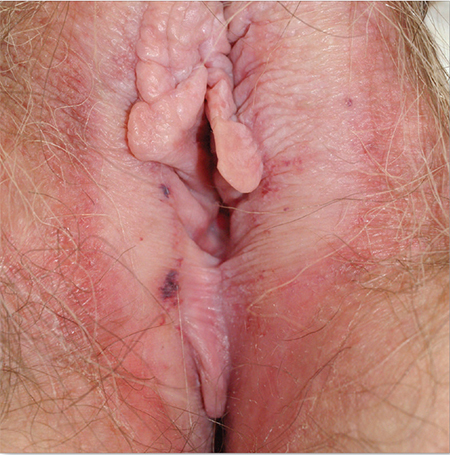
Diagnosis: Lichen sclerosus is a skin disease found most often on the vulva of postmenopausal women, although it also can affect prepubertal children and reproductive-age women. Lichen sclerosus is multifactorial in pathogenesis, including prominent autoimmune factors, local environmental factors, and genetic predisposition.1
Although there is no cure for lichen sclerosus, the symptoms and clinical abnormalities usually can be well managed with ultra-potent topical corticosteroids. However, scarring and architectural changes are not reversible. Moreover, poorly controlled lichen sclerosus exhibits malignant transformation on anogenital skin in about 3% of affected patients.
For more information on this case, see “Chronic vulvar symptoms and dermatologic disruptions: How to make the correct diagnosis.” OBG Manag. 2014;26(5):30-49.


