
Gut Reaction


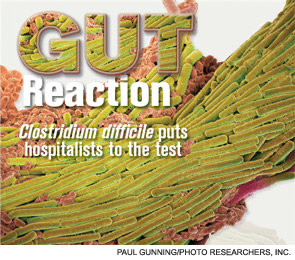
At 480-bed Emory University Hospital Midtown in Atlanta, the physicians and staff seemingly are doing all the right things to foil one of hospital’s archenemies: Clostridium difficile. The bacteria, better known as C. diff, is responsible for a sharp rise in hospital-acquired infections over the past decade, rivaling even MRSA.
In 2010, Emory Midtown launched a campaign to boost awareness of the importance of hand washing before and after treating patients infected with C. diff and those likely to be infected. They also began using the polymerase-chain-reaction-based assay to detect the bacteria, a test with much higher sensitivity that helps to more efficiently identify those infected so control measures can be more prompt and targeted. They use a hypochlorite mixture to clean the rooms of those infected, which is considered a must. And a committee monitors the use of antibiotics to prevent overuse—often the scapegoat for the rise of the hard-to-kill bacteria.
Still, at Emory, the rate of C. diff is about the same as the national average, says hospitalist Ketino Kobaidze, MD, assistant professor at the Emory University School of Medicine and a member of the antimicrobial stewardship and infectious disease control committees at Midtown. While Dr. Kobaidze says her institution is doing a good job of trying to keep C. diff under control, she thinks hospitalists can do more.
“My feeling is that we are not as involved as we’re supposed to be,” she says. “I think we need to be a little bit more proactive, be involved in committees and research activities across the hospital.”
—Kevin Kavanagh, MD, founder, Health Watch USA
You Are Not Alone
The experience at Emory Midtown is far from unusual—healthcare facilities, and hospitalists, across the country have seen healthcare-related C. diff cases more than double since 2001 to between 400,000 and 500,000 a year, says Carolyn Gould, MD, a medical epidemiologist in the division of healthcare quality promotion at the Centers for Disease Control and Prevention (CDC) in Atlanta.
Hospitalists, whether they realize it or not, are intimately involved in how well the C. diff outbreak is controlled. Infectious-disease (ID) specialists say hospitalists are perfectly situated to make an impact in efforts to help curb the outbreak.
“Hospitalists are critical to this effort,” Dr. Gould says. “They’re in the hospital day in and day out, and they’re constantly interacting with the patients, staff, and administration. They’re often the first on the scene to see a patient who might have suddenly developed diarrhea; they’re the first to react. I think they’re in a prime position to play a leadership role to prevent C. diff infections.”
They’re also situated well to work with infection-control experts on antimicrobial stewardship programs, she says.
“I look at hospitalists just like I would have looked at internists managing their own patients 15 years ago,” says Stuart Cohen, MD, an ID expert with the University of California at Davis and a fellow with the Infectious Diseases Society of America who was lead author of the latest published IDSA guidelines on C. diff treatment. “And so they’re the first-line people.”
continued below...
Mayo Shows How a Simple Step Can Make Big Difference in C. Diff

Sometimes even when it comes to a huge problem like widespread bacterial infections, simplicity is best.
The Mayo Clinic, in a project to cut the rate of C. diff infections, asked its workers to do one extra thing: Wipe down high-touch areas with bleach wipes. The effort worked; infections were all but eradicated in units that had been having five to seven infections per month.
The results of the project, recently published in Infectious Control and Hospital Epidemiology, show the importance of simple steps as long as they’re carried out regularly and thoroughly.1
The project began when Robert Orenstein, DO, associate professor of medicine in infectious diseases who then worked in Rochester, Minn., established a surveillance network for C. diff infections at Mayo Clinic at the time when such infections were being noted more widely throughout the U.S. and Canada. The network began tracking the cases and found that one inpatient medical unit primarily composed of patients with gastrointestinal diseases had a C. diff rate 10 times higher than the rest of the hospital. Surveillance also showed that universally gloved hematology and oncology units had substantially lower rates of C. diff infection despite high-risk patients.
Dr. Orenstein knew he had to make a change in the GI unit, but it wasn’t feasible to institute universal gloving, so he turned to bleach wipes.

Twice a day, housekeeping staff wiped down all “high-touch” areas (light switches, toilet handles, bed rails) in all of the rooms. The wipes contain 0.55% sodium hypochlorite. Within six months, the number of C. diff cases fell to almost zero.
“We were just in shock,” Dr. Orenstein says. He attributed the improvement to a reduction in the “colonization pressure”—if a high concentration of patients with C. diff can cause abundant transmissions quickly, the opposite is also true.
The greatly improved figures were shared with housekeeping, which initially complained about the smell but were encouraged to keep doors open and rooms ventilated. The bleach wipes, which Dr. Orenstein acknowledges mean an additional expense, leave a white residue when dry, so the surfaces are wiped down with water after the recommended contact time.
Dr. Orenstein notes that the results came even without a change in hand hygiene, which he had deemed not feasible because of the hospital’s lack of sinks. He isn’t diminishing the importance of hand washing, but the project does show how effective a single step can be.
The key, Dr. Orenstein adds, might be that it was just one change involving just one group of staff. “Why we think it was so effective is it was really one group that had to change their behavior and we worked with them, educated them,” he says.
He emphasizes that the wipes don’t come at the expense of other measures, like thorough cleaning of all rooms and antibiotic stewardship programs.
“You do all of those and do them well,” he says, “then you get the reduction of C. diff in the hospital.”

