
Combo shows early promise for T-cell lymphomas


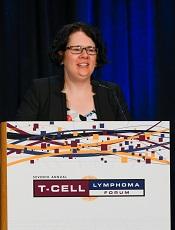
Photo by Larry Young
SAN FRANCISCO—Preclinical and early phase 1 results suggest the aurora A kinase inhibitor alisertib and the histone deacetylase (HDAC) inhibitor romidepsin have synergistic activity against T-cell lymphomas.
In the preclinical study, the drugs showed synergy in cutaneous T-cell lymphoma (CTCL) cell lines and a benefit over monotherapy in vivo.
In the phase 1 study, romidepsin and alisertib produced clinical benefits in patients with peripheral T-cell lymphoma (PTCL).
Unfortunately, there are currently no good markers for predicting which patients might benefit from this type of combination, potentially because the drugs have multivariate mechanisms of action, said Michelle Fanale, MD, of the University of Texas MD Anderson Cancer Center in Houston.
She presented data on romidepsin and alisertib in combination at the 7th Annual T-cell Lymphoma Forum.
Dr Fanale said she was inspired to test the combination (in a phase 1 trial) after researchers reported promising results with the aurora kinase inhibitors MK-0457 and MK-5108 in combination with the HDAC inhibitor vorinostat (Kretzner et al, Cancer Research 2011).
She noted that aurora kinase inhibitors work mainly through actions at the G2-M transition point, while HDAC inhibitors induce G1-S transition. HDAC inhibitors can also degrade aurora A and B kinases, and the drugs modify kinetochore assembly through hyperacetylation of pericentromeric histones.
“When you actually treat with an HDAC inhibitor by itself, you’re basically getting an increase of this sub-G1 population,” Dr Fanale said. “When you treat with your aurora kinase inhibitor by itself, you’re clearly getting an increase of cells that are arresting at G2/M.”
“When you treat with the combination, you’re actually getting a further increase in the sub-G1, denoting dead cells, and then you’re further getting some increase of cells spreading out now through the G2/M portion as well.”
Preclinical research
Dr Fanale presented preclinical results showing that alisertib is highly synergistic with romidepsin in T-cell, but not B-cell, lymphoma. She was not involved in the research, which was also presented at the recent ASH Annual Meeting (Zullo et al, ASH 2014, abst 4493).
The researchers administered romidepsin at IC10-20 concentrations, with increasing concentrations of alisertib, and incubated cells for 72 hours. A synergy coefficient less than 1 denoted synergy.
The combination demonstrated synergy in the HH (CTCL) cell line when alisertib was given at 100 nM or 1000 nM (0.68 and 0.40, respectively) but not at 50 nM (1.05).
Likewise, the combination demonstrated synergy in the H9 (CTCL) cell line when alisertib was given at 100 nM or 1000 nM (0.66 and 0.46, respectively) but not at 50 nM (1.1).
Romidepsin was shown to cause a mild increase in the percent of cells in G1 compared with alisertib, which significantly increased the percent of cells in G2/M arrest. And live cell imaging showed marked cytokinesis failure following treatment.
“When looking at further markers for apoptosis, when giving the combination, there’s further increase in caspase 3 and PARP cleavage, as well as other pro-apoptotic proteins, including PUMA, and a decrease in the anti-apoptotic protein Bcl-xL,” Dr Fanale noted.
She also pointed out that, in an in vivo xenograft model, alisertib and romidepsin produced significantly better results than those observed with monotherapy or in controls.
Phase 1 trial
The phase 1 trial of romidepsin and alisertib in combination included patients with aggressive B- and T-cell lymphomas (NCT01897012; Fanale et al, ASH 2014, abst 1744).
Twelve patients have been enrolled to date. Ninety-two percent of patients had primary refractory disease, they had a median of 3.5 prior lines of therapy (range, 1 to 7), and none of the patients had received a stem cell transplant.

