
Severe headache


A 72-year-old white woman was brought to her family physician (FP) because she’d had a severe headache for a day; she was nauseous and vomiting. Her son said she seemed sleepy and was slow to answer questions. The patient had a history of difficult to control high blood pressure. In the office, the patient was slouched over in a wheelchair and her blood pressure was 212/124 mm Hg. Her neck was stiff and she wasn't speaking. The FP sent her for an emergency computed tomography scan.
What's your diagnosis?
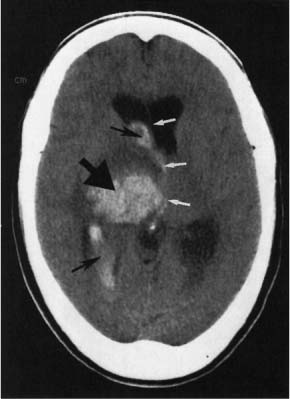
The CT scan showed a hemorrhagic stroke with bleeding in the right basal ganglia (large black arrow) and into the ventricles (small black arrows). (The white arrows illustrate midline shift.)
As is true for ischemic strokes, the main risk factor for hemorrhagic strokes is hypertension. In hemorrhagic strokes, it is important to not aggressively lower blood pressure. Some authorities recommend lowering blood pressure only when mean arterial pressure (MAP) is >130 mm Hg. After the hemorrhagic stroke is over, blood pressure should be treated aggressively. Modest decreases in blood pressure (12/5 mmHg) from one of many classes of hypertensive drugs lower recurrent stroke risk by 50% to 75%.
Photo courtesy of Chen MY, Pope TL, Ott DJ. Text for Photo Rounds Friday courtesy of Richard P. Usatine, MD. This case was adapted from: Chumley H. Cerebral vascular accident. In: Usatine R, Smith M, Mayeaux EJ, et al, eds. The Color Atlas of Family Medicine. New York, NY: McGraw-Hill; 2009:968-971.
To learn more about The Color Atlas of Family Medicine, see:
• https://www.amazon.com/Color-Atlas-Family-Medicine/dp/0071474641
You can now get The Color Atlas of Family Medicine as an app for mobile devices including the iPhone, iPad, and all Android devices by clicking this link: