
Expanding Naloxone Distribution to Veterans at Risk for an Opioid-Involved Overdose Through a Facility Automated Call Initiative


Background: The mortality rate from opioid-related overdoses remains higher than before the COVID-19 pandemic. Veterans receiving Veterans Health Administration (VHA) care are at an increased risk for opioid-involved overdose death compared with the US population. Increasing naloxone distribution reduces the risk of opioid-involved overdose deaths. The VHA implemented an opioid overdose education and naloxone distribution program to reduce opioid-involved overdose deaths among veterans. Veteran Health Indiana launched a pilot quality improvement initiative using an automated call platform to improve naloxone distribution. Veterans at risk for an opioid-involved overdose without an active naloxone prescription received automated calls and were offered a prescription for naloxone through this program.
Observations: The Veteran Health Indiana Pharmacy service and Pain Management, Opioid Safety, and Prescription Drug Monitoring Program (PMOP) coordinator launched an automated call initiative. Veterans at risk for opioid overdose without an active naloxone prescription were contacted by a facility-developed, customized, automated call and offered a naloxone prescription. About 540 prescriptions were issued for naloxone following automated calls from May 6, 2024, through May 19, 2025.
Conclusions: This single-center, quality improvement initiative at a Level 1A tertiary care VHA system demonstrated that automated outreach telephone messaging can increase the distribution of naloxone to veterans at risk for an opioid-involved overdose.
In the early 1990s, the United States experienced a rise in opioid-involved overdose deaths.1 Since then, there have been waves of the opioid epidemic, with increases in opioid-involved overdose deaths driven first by prescription opioids, then heroin, followed by synthetic opioids, and most recently by polysubstance use, including stimulants.2 The number of opioid-involved overdose deaths declined from 83,140 in 2023 to 54,743 in 2024.3 The decline has been attributed to several factors, including increased access to naloxone, expanded substance use treatment services, changes in drug usage patterns, monetary impacts from opioid-related lawsuit settlements, and a decrease in the at-risk cohort.4 Despite declines, the annual rate of opioid-involved overdose mortality remains higher than before the COVID-19 pandemic, emphasizing the need for continued low-barrier access to opioid overdose education and ongoing deployment of risk mitigation strategies.
Veterans receiving Veterans Health Administration (VHA) care are at an increased risk for opioid-involved overdose deaths compared with the nonveteran population and veterans receiving care outside the VHA.5 Compared with the US population, veterans are twice as likely to experience a fatal overdose event.6 The heightened risk is attributed to psychosocial factors, including increased rates of mental health conditions, military sexual trauma, social isolation, lack of housing, suicide risk, and low rates of health care use.7 Low-barrier access to naloxone is critical to reducing opioid-involved overdose deaths.
The US Food and Drug Administration has approved naloxone for the emergency treatment of known or suspected opioid involved overdose events.8 Increased distribution of naloxone through community overdose education and naloxone distribution (OEND) programs has demonstrated a reduction in opioid-involved overdose deaths.9
Strategies to increase naloxone distribution include increasing the access and supply of naloxone in communities (supply-based distribution) and increasing direct distribution to individuals at risk (demand-based distribution). Data models demonstrate that both the supply-based and demand based distribution strategies reduce opioid involved overdose deaths independently and synergistically.10 Importantly, naloxone distribution is more likely to reduce opioid-involved overdose deaths when patients and caregivers receive education and when opioid-involved overdose events are witnessed.11
To address rising opioid-involved overdose deaths among veterans, the VHA initiated a single-facility pilot OEND program in April 2013 and adopted a national OEND program in November 2015.12 The national OEND program provided clinical guidelines for clinicians prescribing naloxone to veterans at increased risk for opioid-involved overdose, expanded education resources for clinicians and patients, developed policies and guidance for implementation at sites, and funded OEND-trained clinical pharmacists to partner with clinicians. The Comprehensive Addiction and Recovery Act of 2016 allowed all veterans to receive naloxone without a copay, regardless of their service-connected prescription copay status.13
To better identify veterans at risk for an opioid-involved overdose, the VHA developed the Stratification Tool for Opioid Risk Mitigation (STORM) algorithm, a validated tool that uses patient demographics, previous overdose or suicide attempt, treatment risk indicators, prescriptions, substance use and mental health disorder diagnoses, and medical comorbidities as predictive risk variables. The tool includes a dashboard that identifies veterans receiving care within VHA facilities at stratified levels of risk for an opioid-involved overdose event, provides patient-specific risk mitigation strategies, and prompts an annual assessment of veterans identified at elevated risk for overdose or suicide events.14
In addition to identifying veterans through STORM, VHA guidelines advise clinicians to offer naloxone to veterans at increased risk for opioid-involved overdose. This includes veterans with diagnosed opioid use or stimulant use disorder, an opioid or stimulant overdose within the past year, a loss of tolerance or increased risk of nonprescribed opioid use, a prescription for an opioid with a daily oral dose > 50 morphine milligram equivalents, or nonprescribed opioid use.15 Each VHA facility also is intended to have a Pain Management, Opioid Safety, and Prescription Drug Monitoring Program (PMOP) coordinator who oversees components of the national OEND program, including naloxone distribution. Although the national VHA OEND program, STORM dashboard, VHA PMOP program office, and practice guidelines support broad distribution of naloxone, gaps in naloxone distribution to at-risk veterans persist.16
Veteran Health Indiana (VHI) serves about 62,000 veterans and completes 736,000 outpatient encounters annually.17 VHI dispenses naloxone directly to patients through 2 outpatient pharmacies and the consolidated mail outpatient pharmacy (CMOP). To encourage naloxone distribution, VHI permits any pharmacist to prescribe it and provides expanded naloxone education for pharmacists. In addition, the VHI Surgery service receives education to encourage postsurgical naloxone distribution. On May 6, 2024, VHI began an initiative to offer naloxone through an interactive, automated call platform.
Automated Call Program
This single-center, continuous quality improvement project began May 6, 2024, at VHI to increase naloxone distribution among veterans at increased risk for an opioid-involved overdose death. The VHI PMOP coordinator, the pain and palliative care program manager, and the chief of pharmacy collaboratively developed the initiative to increase naloxone distribution using the automated call platform (Figure 1). When contacted, veterans received the following interactive, prerecorded message:
Hello from the Indianapolis VA. We are offering free naloxone kits to all veterans in an attempt to increase access to this lifesaving medication in the community. Naloxone, also known as Narcan or Kloxxado, is a medication that can reverse the effects of opioids in an emergency, such as an overdose. Use of naloxone could be lifesaving to you, a family member, or anyone in your community. Would you like to be mailed a free, potentially lifesaving naloxone kit to your address? Press 1 for yes. Press 2 for no. Press 3 if you would like to receive a call back from a pharmacist to further discuss the naloxone. Thank you for your time and have a great day.
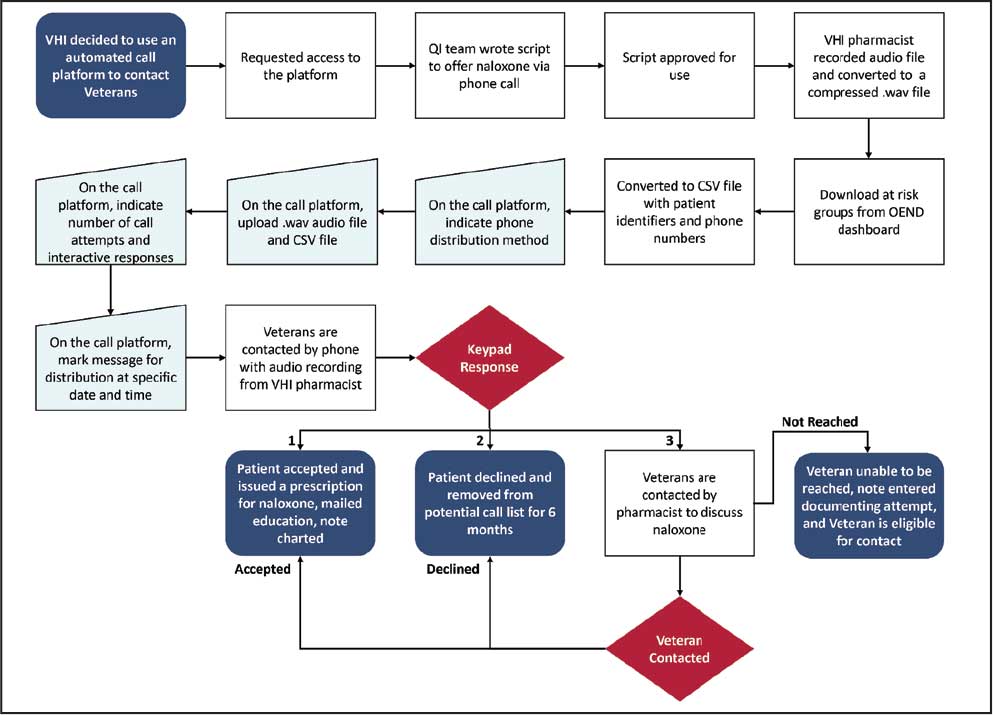
Process Map
Abbreviations: CSV, comma separated value; OEND, overdose education and naloxone distribution; QI, quality improvement; VHI, Veteran Health Indiana.
Veterans were contacted through the automated call platform if they received care at a VHI location, had a valid phone number, were identified as being at risk for an opioid-involved overdose, and did not have an active naloxone prescription in the previous 12 months at a US Department of Veterans Affairs (VA) pharmacy location. Veterans were ineligible for outreach if they did not have an active phone number on file or had declined naloxone in the previous 6 months. Calls were conducted weekly, targeting different at-risk groups. Cohorts were identified using a VHA dashboard that identifies veterans at risk for an overdose event, stratified by risk factors.
When a veteran accepted a naloxone prescription by pressing 1 during the call, the PMOP coordinator generated a prescription for intranasal naloxone 4 mg or 8 mg, based on VHA guidance, to be mailed. Additionally, educational materials developed by the Academic Detailing Service were issued to the patient through the secure messaging platform or mail, and a note was entered in the electronic health record (EHR). If a veteran declined the naloxone prescription by pressing 2, the decision was documented in the EHR and the veteran was removed from the call list for 6 months. If a veteran requested a callback by pressing 3, the veteran was contacted by an OEND-trained pharmacist within 72 hours. The system was set to make 3 total contact efforts if the first attempted call was unsuccessful.
Quality Improvement Initiative
There were 15,317 attempted contacts between May 6, 2024, and May 19, 2025 (Figure 2). Of note, those included in contact efforts were targeted multiple times throughout the effort to obtain responses from those identified in at-risk cohorts. As risk groups were attempted multiple times, it allowed for the same patients to be contacted on separate days and different times to reach more veterans. In this time, 692 responses were received and 491 veterans accepted a naloxone prescription during the automated call. Sixty-four individuals requested a callback and 52 (81%) accepted naloxone at the follow-up consultation. The acceptance rate for naloxone prescriptions was 78.5% of respondents.
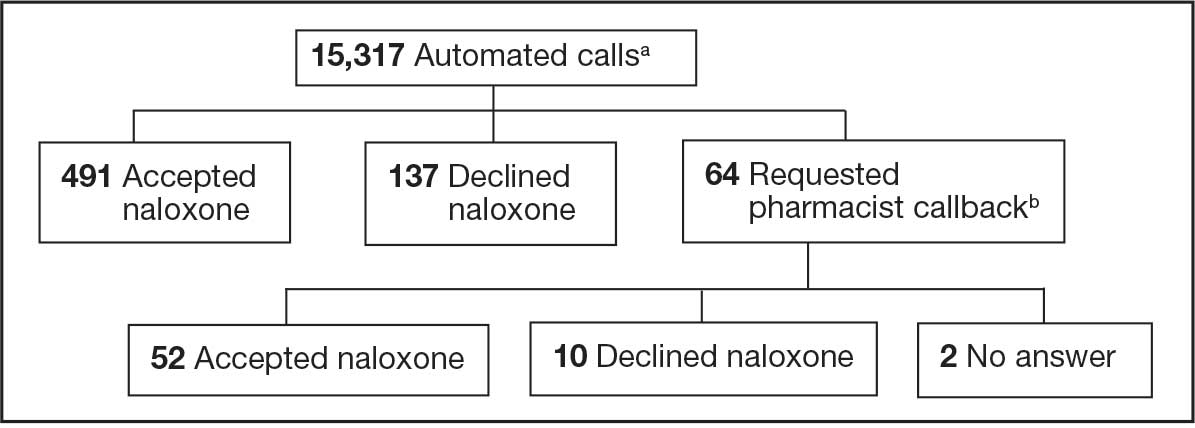
aEligible patients could be contacted multiple times if not reached.
bData extrapolated from 6-month sample due to restricted data retention.
The mean number of weekly attempted contacts was 284 (range, 77-1254). Weekly call volume was increased throughout the duration of this quality improvement initiative by the quality improvement workgroup. The mean weekly call volumes during the initial 1-month interval, the initial 6-month interval, and the second 6-month interval were 211, 262, and 303, respectively. The acceptance rate of naloxone declined over the course of the initiative: the acceptance rates during the initial 1-month interval, the initial 6-month interval, and the second 6-month interval were about 85%, 81%, and 75%, respectively.
There was a mean of 1.1 pharmacist callback requests per week (range, 0-7). Most patients who asked for a pharmacist callback accepted a prescription for naloxone after their discussion. A naloxone rescue kit and educational materials were mailed after consent was received from the patient, whether from an affirmative response during the call or after speaking with a pharmacist. According to EHR data, the mean age of patients who received a naloxone rescue kit was 64 years, 90% were male, and 70% identified as White race.
Discussion
This quality improvement initiative highlights the potential for automated interactive phone calls to increase naloxone distribution within the VHA. There is limited research examining the use of automated communication in health care settings or for naloxone distribution. Previous studies have examined the use of automated calls and texts in pharmacy settings to reduce prescription abandonment rates; however, these studies have not consistently demonstrated a statistically significant benefit.18,19 A previous study demonstrated the feasibility of community pharmacist-led phone calls to discuss safe opioid storage and naloxone ownership.20 Within the VHA, patients were more likely to receive a naloxone prescription if they received a pharmacist-initiated phone call plus a letter compared with patients who received a letter alone.21 Our study appears to be the first to evaluate the use of automated patient calls to increase naloxone distribution.
The VHA has made sweeping efforts to improve naloxone distribution; however, many initiatives are labor-intensive and remain dependent on manual interventions. VHA clinicians who have received an OEND academic detailing visit prescribe naloxone frequently (3.0–17.9 monthly naloxone prescriptions). 22 This study demonstrates that an automated patient contact system can increase naloxone distribution efficiently and with minimal labor requirements, and can complement other measures such as direct prescribing by clinicians, dashboard monitoring, and naloxone-focused events.
Although the approach is primarily automated, implementation of an automated call platform for naloxone distribution requires manual labor to initiate and maintain. Patient lists with accurate phone numbers were exported from STORM. In addition, a pharmacist must be available to call veterans back when requested, enter naloxone prescriptions, issue educational materials, and document acceptances and refusals in the EHR.
Despite considerable efforts to increase naloxone distribution, additional investigation is needed to continue these lifesaving efforts. A medical student will be assigned to lead efforts targeting at-risk populations in need of naloxone at VHI. Future work will aim to compare the effectiveness of targeting at-risk cohorts through the automated call platform with that of traditional naloxone distribution methods. Phone calls are an established care modality for naloxone distribution to veterans, but our team is aware of few federal health care systems using automated phone calls.23 It is unknown how many VHA facilities use an automated call system to offer naloxone; further efforts will aim to gather data from multiple VHA facilities to determine whether the automated call process is widely used for naloxone distribution.
Limitations
Automated patient contact systems have shown a variety of response rates across age subgroups.18 Calls were made at various times between 9:00 am and 4:00 pm, which may have limited responses, particularly among veterans who work during normal business hours. Automated calls may have been screened and marked as spam, which could have reduced the response rate. This initiative showed a slightly declining acceptance rate by respondents over time, which may be due to a saturation effect as veterans who are most likely to accept a naloxone prescription through the automated call platform accepted the prescription earlier in the initiative. The decline in acceptance rate may also be confounded by increased distribution of naloxone through other initiatives such as International Overdose Awareness Day events that widely offered naloxone to interested veterans.
Conclusions
This quality improvement initiative demonstrates that a novel naloxone distribution program using an automated call platform can increase the distribution of naloxone to veterans at risk for opioid-involved overdose. The automated call platform has allowed naloxone to be offered widely to at-risk individuals and uses existing risk-stratification tools. The effort requires significantly less labor to maintain than cold calls from clinicians. Other VHA sites may consider using an automated call platform to increase the distribution of potentially lifesaving naloxone prescriptions.
