Pediatric Residency Graduates Find Hospitalist Practice Increasingly Irresistible


Major Finding: 73% of pediatric residents who took a hospitalist position upon graduation over the last 5 years had hospitalist practice as their long-term goal.
Data Source: American Academy of Pediatrics’ annual graduating residents survey.
Disclosures: None.
FROM THE ANNUAL MEETING OF THE PEDIATRIC ACADEMIC SOCIETIES
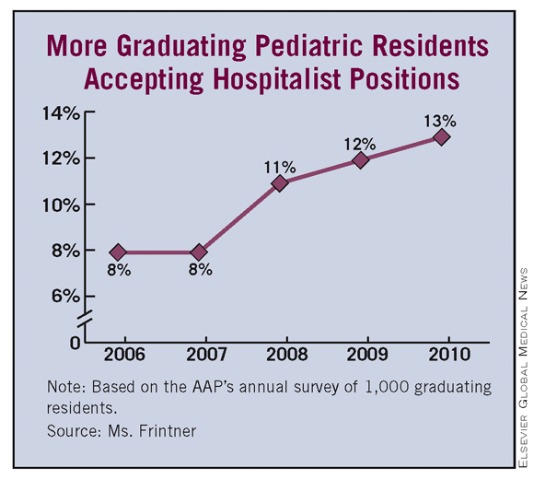
DENVER – Last year, roughly one in eight graduating pediatric residents accepted a hospitalist position.
These new pediatricians aren’t merely using the job as a stepping stone, either. Fully 84% of those who took a hospitalist position straight out of residency in 2010 say that being a hospitalist is their long-term career goal, Mary Pat Frintner said at the annual meeting of the Pediatric Academic Societies.
She presented highlights from the past 5 years of the American Academy of Pediatrics annual survey of graduating residents, administered to a random sample of 1,000 new graduates each year.
The proportion of graduating pediatric residents accepting a hospitalist position rose steadily from 8% in 2006 to 13% last year. Few of them reported any substantial difficulty in their job search: 45% indicated they experienced no difficulty at all in landing their position, and only 14% reported moderate and 3% considerable difficulty, according to Ms. Frintner of the department of research at AAP headquarters in Elk Grove Village, Ill.
Fifty-eight percent of the new pediatric hospitalists took a position in the same city as their residency. Two-thirds stayed in the same state.
The average full-time starting salary over the 5-year study period for residents taking a hospitalist position was $122,000 per year, with no significant increase over the years. Fifteen percent of 2010 grads who took a hospitalist position accepted a part-time, reduced-hours position.
Fifty-eight percent of the new pediatric hospitalists indicated that they will be working in a medical school or teaching hospital, and 36% in a community hospital. Community hospitals paid better.
Significant predictors of acceptance of a hospitalist position were having graduated from a residency training program with 60 or more residents, an educational debt of $120,000 or more, age less than 31 years, being nonmarried, and having gone to a U.S. medical school. Each of these predictors was only modest in power. Neither gender nor having children was significantly associated with taking a hospitalist position.
Across the full 5-year study span, 73% of those who took a pediatric hospitalist position upon graduation had hospitalist practice as their long-term goal. Twelve percent were aimed towards subspecialty practice, 10% had primary care pediatrics as their career goal, and 4% looked to a future involving a combined primary care/subspecialty practice.
Audience members commented that this AAP-funded study provides persuasive evidence in support of recognizing hospitalist practice as a pediatric subspecialty.
"With 13% of residents in 2010 going into it, if it were to be a pediatric subspecialty it would be the biggest subspecialty," one physician observed.
Of the roughly 30,000 hospitalists practicing today, only about 10% are believed to be pediatricians, Ms. Frintner noted.