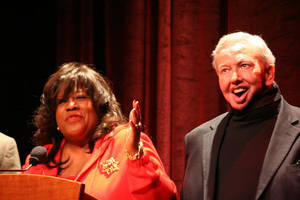
Charlie “Chaz” Ebert, wife of movie critic Roger Ebert, received compassion and understanding from the oncology team responsible for her husband’s care during his excruciating battle with salivary gland cancer. What she didn’t get, she said, was “fair warning” that her ever-optimistic, take-life-by-the-horns partner might decide not only to give up the fight at some point, but that he might want her help in ending it.
Photo credit: Flickr user mc1968a (Creative Commons)
Chaz and Roger Ebert
Euthanasia “is never discussed openly, but the topic is out there and it’s terrifying,” Mrs. Ebert said during a roundtable discussion titled “The Many Faces and Challenges of Caregivers” led by veteran ABC news journalist Sam Donaldson at the annual conference of the National Comprehensive Cancer Network (NCCN) in Hollywood, Florida, last week. With respect to her husband, “here’s someone whose whole life was about speaking and sharing information, and he lost his ability to speak. He was also someone who loved food and eating with his friends and family and he wasn’t going to be able to eat.”
She knew those realities were going to be devastating for him, but she also knew – or thought she knew – that her husband loved life “and that somehow we would find a way through this.” That certainty was shattered, however, when, after waking up from a procedure that left him partially and temporarily paralyzed, her husband scribbled “kill me” on a piece of paper. Shaken by the depth of her husband’s pain, “I told him that wasn’t an option. He was looking at me to give him some direction, so I told him, ‘If you will find the will to live I will find a way to make your life interesting for you.’ ” He did persevere, and she has made good on her promise, “but I feel like I should have been better prepared to handle the emotional rollercoaster,” she said.
Jai Pausch, wife of the late Randy Pausch, the Carnegie Mellon professor and author of The Last Lecture, which he wrote while terminally ill with pancreatic cancer, shared a similar story in the hope that it might help oncologists understand that shielding caregivers from certain realities, although well meaning, can leave them more vulnerable to the crushing blows when they occur. “My husband, who had always been very optimistic and very positive told me that he didn’t want to be a freak show for our children and if he got to the point where he was to be comatose in that slow progression of dying, he wanted me to give him an overdose of morphine to speed the process along.”
Up until that point, “I would have done anything for him. I didn’t know how to respond. I couldn’t go there,” Mrs. Pausch said. “I later learned that this is something that a lot of patients talk to their caregivers about, that it’s a normal part of the process, but it’s something that nobody tells you.”