
Psoriasis Area and Severity Index Use in Pediatric Psoriasis


Psoriasis Area and Severity Index (PASI) score is the primary instrument used to assess psoriasis severity and determine eligibility for clinical trials. The PASI scoring system assumes fixed adult body surface area (BSA) proportions for the head (10%), upper extremities (20%), trunk (30%), and lower extremities (40%); however, these proportions differ in pediatric populations. We conducted a systematic review of articles in Embase, PubMed, and Scopus, identifying more than 300 records. After quality appraisal using the Literature Review Scoring Rubric and manual relevance screening, 5 high-quality studies were included in our review. None addressed modification of PASI to account for age-related differences in BSA distribution. Because PASI scoring is used to determine pediatric clinical trial eligibility, reliance on adult BSA proportions may result in overinclusion or underinclusion of children. Based on these findings, we propose a modified PASI incorporating pediatric BSA estimates derived from the Parkland formula to improve accuracy in children and adolescents.
PRACTICE POINTS
- The Psoriasis Area and Severity Index (PASI) scoring system uses fixed adult body surface area (BSA) proportions, which may inaccurately estimate disease severity in pediatric patients due to age-related differences in BSA distribution.
- Reliance on unmodified PASI scoring in children may lead to overinclusion or underinclusion in clinical trials and potentially misguide treatment decisions.
- Clinicians should recognize that pediatric patients have proportionally larger heads and different extremity surface areas compared to adults, which may affect psoriasis severity calculations.
- Incorporating pediatric-specific BSA estimations may improve accuracy when assessing psoriasis burden in children.
The Psoriasis Area and Severity Index (PASI) scoring system was formulated to quantify adult psoriasis disease burden in clinical trials.1 A patient’s PASI score is reported as a number between 0 and 72, with a score between 5 and 10 considered moderate. A score greater than 10 signifies that the disease is severe.2 The score is calculated by assessing the head, upper extremities, trunk, and lower extremities for erythema, induration, and scaling. A numerical value of 0 (none) to 4 (severe) is assigned for each of these categories in each of these areas; thus, a total score ranging from 0 to 72 is possible.2
The PASI scoring system assumes that the head, upper extremities, trunk, and lower extremities make up 10%, 20%, 30%, and 40% of the total body surface area (BSA) in a typical adult, respectively2; however, children have different relative BSA. Their heads are larger proportional to the body, and the extremities have higher BSA. This difference also should be accounted in the assessment of burns. Clinicians typically use the first-aid formula,3 otherwise known as the Rule of Nines, for estimating the proportion of BSA burned; however, this formula, which divides the adult body into regions totaling 100%—typically 9% for the head and each upper extremity, 18% for each lower extremity and the anterior and posterior trunk, and 1% for the perineum—fails to make adjustments for the differences in the relative BSAs of children and adults.4 In 1944, Lund and Browder5 proposed age-specific percentages of total BSA assigned to individual body regions for patients aged 0 years, 1 year, 5 years, 10 years, 15 years, and adults. Although imperfect, this approach addressed differences in body surface area distribution between children and adults and emphasized the need for age-adjusted estimation.
The assumptions that PASI scoring relies on to quantify psoriasis severity may lead to overestimation or underestimation of psoriasis burden and progression in pediatric patients. Other scoring systems include the Physician Global Assessment and the Simplified Psoriasis Index (SPI), both self-assessed (saSPI) and provider-assessed (proSPI). Only the PASI and SPI assess BSA involvement. Both systems base their surface area calculations on adult findings.2,6
In adult and pediatric populations, PASI is used to assess medical management efficacy as well as for acceptance into clinical trials.7 The use of PASI as an inclusion criterion for pediatric trials could potentially skew which patients are included. This challenge is reminiscent of historic issues in burn care, where early formulas like the first-aid/Rule of Nines formula for burns underestimated differences in pediatric and adult BSA distributions. The purposeful development of the children’s Parkland formula addressed these differences by modifying surface area percentages for children, leading to more accurate assessments and better treatment outcomes.8 Similarly, a tailored PASI for pediatric populations could ensure precise assessment of disease severity and improved therapeutic interventions.
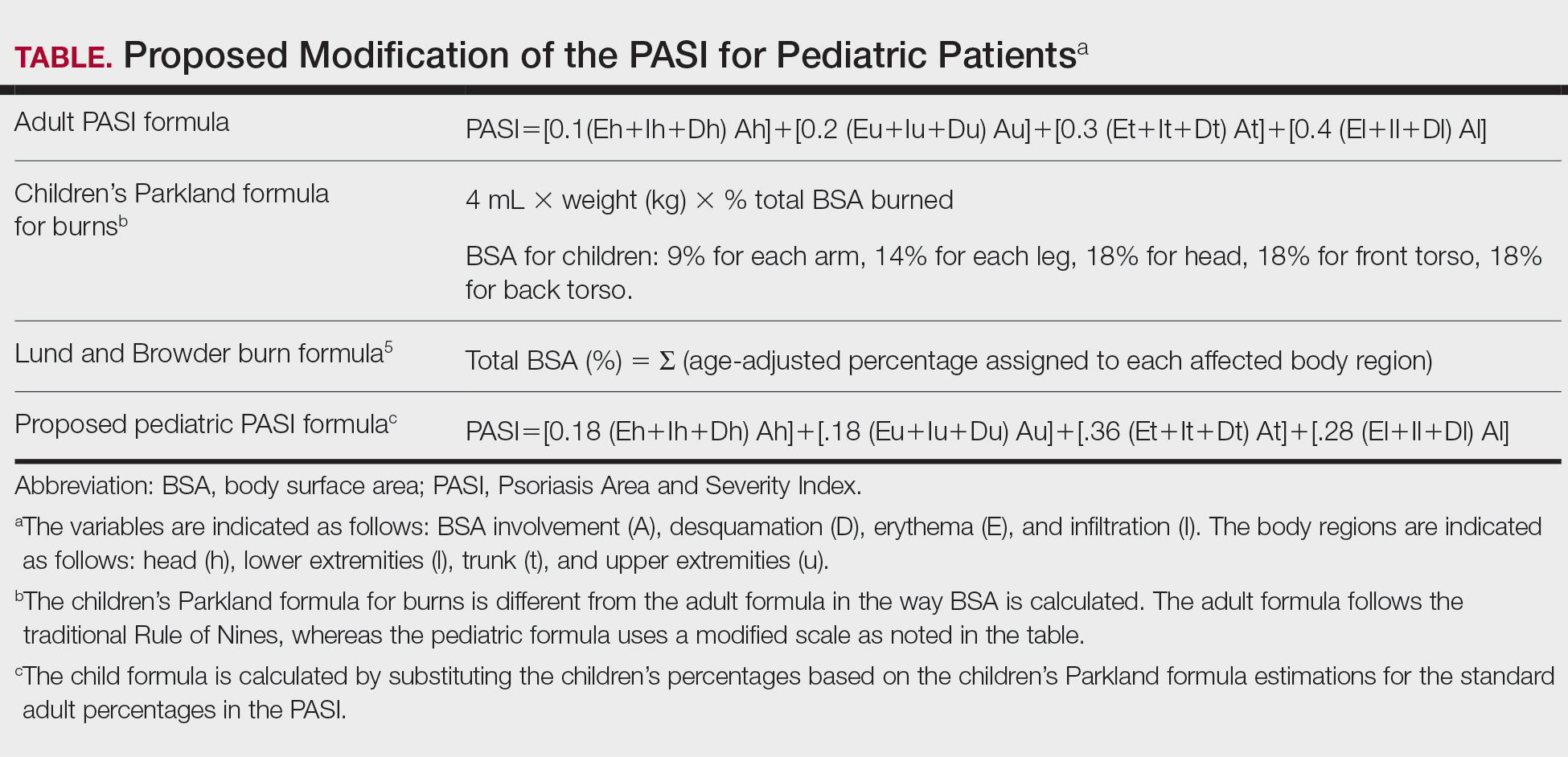
Given the different distribution of BSA, we conducted a review of the literature to evaluate the role of PASI scoring in pediatric populations. We propose a new psoriasis scoring system for children based on combining the PASI system, children’s Parkland formula for burns, and the Lund and Browder burn formula (Table).
Materials and Methods
We performed a literature review of articles discussing pediatric assessment of psoriasis using the PASI scoring system using PubMed, Embase, and Scopus. Search terms included pediatric psoriasis, PASI, index, and score were used to help narrow the results. Only articles published in the past 5 years were included to ensure medical accuracy in the findings. Five years was the chosen time frame because psoriasis, and even pediatric psoriasis, has been a hot-button topic with changing treatment options and recommendations over this period of time.
The initial search yielded more than 300 results. After specifying for the key search terms to be in the title or abstract, we narrowed the results to 85 articles. We removed duplicate articles and scored each article using the literature review scoring rubric by Boote and Beile.9 This rubric was specifically chosen as a framework to evaluate the quality of the literature identified in this systematic review. While originally developed for assessing dissertation reviews, its emphasis on methodologic rigor and relevance is applicable to synthesizing studies in any research field. By applying this tool, we ensured that the included studies were representative of current clinical practice regarding the PASI and highlighted critical gaps in its application to pediatric populations.
Articles were included in the final sample if they showed relevancy to the topic in the abstract and passed every rubric category. Articles were excluded from the final sample if, after a brief review, they were deemed to be irrelevant to the topic or if they failed any categories of the rubric. The final sample contained 5 articles.
Results
In 2017, van Geel et al10 recruited 113 pediatric patients with psoriasis with a median age of 12 years (range, 4-17 years). The investigators scored their disease severity using PASI and Children’s Dermatology Life Quality Index (CDLQI) scores as the standard, then compared them with saSPI and proSPI scores. They found the highest score correlation strength between proSPI and PASI, with slightly lower correlations between saSPI and PASI. The saSPI was closely correlated with CDLQI scores. This suggested that both scales could be utilized in pediatric groups but that the patients’ understanding of their disease burden might be better correlated to the saSPI.10
Lavaud and Mahé11 performed a systematic literature review in 2019 to evaluate severity scores in the management of childhood psoriasis. Results revealed that the PASI was the most frequently used scale in evaluating quality of life in patients with pediatric psoriasis; however, more than half of the studies the authors evaluated did not discuss how the threshold for severity was determined. This leaves substantial ambiguity in whether the authors are using a standardized scoring system to track treatment progress. Furthermore, in the studies that did describe disease severity, there were inconsistencies in PASI score assignment, and consideration was not given to BSA evaluation for pediatric patients. This is concerning because PASI score also is a pillar metric in clinical trials that approve psoriasis drugs for pediatric use, and without defining thresholds for severity in pediatric patients, it becomes impossible to make comparisons of drug efficacy in this group.11
Kim and Fischer12 studied 157 pediatric patients with psoriasis (aged ≤16 years) to determine whether there was a relationship between PASI and Family Dermatology Life Quality Index (FDLQI)—a reliable and validated quality-of-life index for the family members of patients having any skin disease. A standard treatment protocol was followed for refractory cases of psoriasis, and the FDLQI was administered before and after treatment. In this study, mean and median PASI were calculated. The study concluded a strongly positive correlation between PASI and FDLQI. There is no description of whether the PASI scale was modified for the pediatric population, and the FDLQI questionnaire is unmodified from the adult version. The authors referenced a previous study that showed a similar correlation to their results, which is meant to validate the results of this study; however, they also noted a difference in the mean PASI score in the studies. They did not offer an explanation on why this difference exists. It is likely due to the inherent subjectivity of the PASI scale in addition to nonstandard modifications made to accommodate pediatric patients.12
Nourmohammadpour et al13 studied 40 pediatric patients with psoriasis with a mean age of 12.42 years (range, 4-16 years) in 2022. They compared CDLQI and PASI scores, finding a significant correlation between the two (P<.001; r=0.653). The adult PASI scale was used with no modification for pediatrics; this means that the true PASI score will vary from the one calculated for each patient in this study. Given that the true PASI score is not directly proportional to the adult score, the strength of correlation concluded in this study is questionable. A clear relationship between CDLQI and PASI scores cannot be determined if the PASI is not modified for children’s proportions because children and adults are not directly proportional in size, making a key independent variable in this study inaccurate.
Bruins et al14 recruited 319 pediatric patients with psoriasis with a median age of 10 years and measured how their CDLQI scores changed as they underwent treatment. The authors then compared these CDLQI trends with PASI trends, looking for correlation. They found that patients who achieved PASI90 or higher or a BSA response greater than 90% had the highest CDLQI improvements. Both BSA and PASI scores were used with adult surface areas to estimate disease involvement, assuming that the head represents 10%, the upper extremities are 20%, the trunk is 30%, and the lower extremities are 40% of the total body surface rather than age-appropriate pediatric proportions.15
The results from our literature review demonstrate major reliance on unmodified PASI calculations, underscoring the lack of pediatric-specific adaptations. This highlights a critical gap: failure to account for the differing BSA distributions of children, which may result in inaccurate assessments and misaligned treatment protocols.
Comment
Our literature review identified a lack of studies comparing psoriasis disease burden and quality of life that modify standardized scoring systems (PASI, BSA, SPI) to account for differences in BSA distribution among pediatric and adolescent patients. Not modifying the PASI for children’s body proportions leads to patient underinclusion or overinclusion in clinical trials that drive treatment recommendations today. As a result, these study findings and the guidelines derived from them may have limited external validity. This gap highlights a major unmet need in pediatric psoriasis: the absence of a clearly defined severity threshold contributes to ambiguity and has led to variability in the evaluation and management of psoriasis in this population.
Historically, pediatric psoriasis studies have used the PASI scoring system, as it is the gold standard for evaluating adult psoriasis. There are alternative scales with higher interrater reliability that can be modified to children’s body proportions; for example, the Psoriasis Global Assessment and a newer measure, the Lattice System Physician’s Global Assessment, are modifiable options with high interrater reliability.16
There is much room for improvement in how pediatric psoriasis is evaluated and graded. The CDLQI was specifically developed to assess quality-of-life changes in pediatric patients, and similar progression should be possible with the PASI. Drawing from related fields, adaptations such as the Eczema Area and Severity Index (EASI) for children younger than 8 years have shown the potential benefits of modifying clinical tools for pediatric use. Adjustments to the EASI—such as increasing the head/neck multiplier to 0.2 and decreasing the lower extremities multiplier to 0.3—enhanced the accuracy of disease-severity assessments in younger populations.17 By integrating similar principles, a modified PASI could bridge the gap between adult-centered metrics and the unique anatomic proportions of pediatric patients.
We propose a modified PASI scale that integrates pediatric burn surface area estimates with the existing PASI system (Table). The pediatric modification of the Rule of Nines accounts for differences in body surface area proportions in children, assigning 9% to each arm, 14% to each leg, 18% to the head, 18% to the anterior trunk, and 18% to the posterior trunk. Similar formulas could be created using the Lund and Browder5 BSA percentages based on different pediatric ages. Our formula modifies the existing BSA percentages currently used in adult psoriasis for children’s body proportions. Testing and validation would be needed to standardize this formula to pediatric patients with psoriasis; however, these modifications would be a step in the right direction to address the unmet need in this field.
In order for clinicians to more reliably assess disease burden in pediatric patients with psoriasis for clinical trial inclusion, grading scales such as PASI, BSA, and SPI must be modified for surface area differences in children. Our results demonstrate a paucity of articles in the literature using skin-surface estimations based on children’s proportions. Further investigation should be done to explore estimation of disease burden in the pediatric age group. A new formula would require case series standardization and validation to be broadly applied and accepted as the standard for assessing pediatric psoriasis.
Conclusion
In summary, this review identifies a pressing need for a pediatric-specific PASI. Historical precedents, such as the development of the children’s Parkland formula and modifications to the EASI, demonstrate that tailoring clinical tools to pediatric proportions improves both assessment accuracy and treatment outcomes. Without such adaptations, the PASI risks compromising the validity of disease burden assessments and the equitable inclusion of pediatric patients in clinical trials. Addressing this gap is essential to advance the care for pediatric patients with psoriasis.
