
Purple growths on arm


A 32-year-old man asked his family physician (FP) to look at the large purple growths that had begun developing on his left arm 2 years earlier. Initially he thought they were bruises from doing some heavy lifting at work. The growths were tender to the touch, compressible, and appeared vascular in nature. No other family members had this condition
What's your diagnosis?
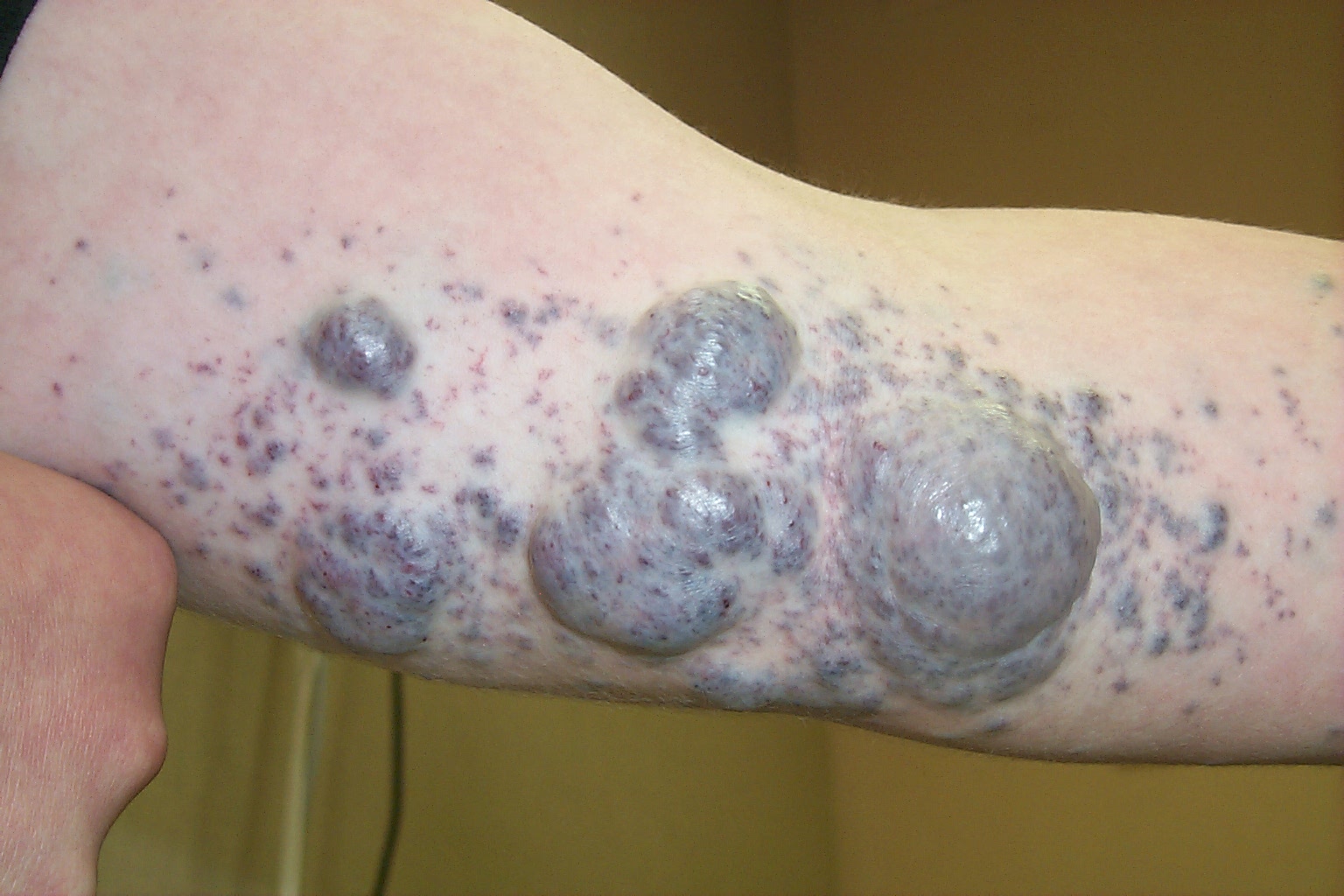
A punch biopsy on one of the small purple spots on the patient’s arm revealed that the growths were glomangiomas, also known as glomuvenous malformations and glomus tumors. Glomangiomas are rare and are caused by abnormal synthesis of the protein glomulin. About two-thirds of patients with glomangiomas have a family history of similar lesions.
Glomangiomas are blue-purple, partially compressible nodules with a cobblestone appearance. Lesions are tender to the touch and tend to occur on the extremities. Solitary glomangiomas often occur in the nail bed.
Skin biopsy of glomangiomas reveals distinct rows of glomus cells that surround distorted vascular channels. Isolated glomangiomas may be surgically excised. Sclerotherapy may be useful for multiple lesions or large segmental lesions. This patient was referred to a vascular surgeon to discuss treatment options.
Text for Photo Rounds Friday courtesy of Richard P. Usatine, MD. Photo courtesy of Jack Resneck, Sr., MD. This case was adapted from: Hitzeman N. Acquired vascular lesions in adults. In: Usatine R, Smith M, Mayeaux EJ, et al, eds. The Color Atlas of Family Medicine. New York, NY: McGraw-Hill; 2009:861-864.
To learn more about The Color Atlas of Family Medicine, see:
• https://www.amazon.com/Color-Atlas-Family-Medicine/dp/0071474641
You can now get The Color Atlas of Family Medicine as an app for mobile devices including the iPhone and iPad by clicking this link: